
Small business owners ask us all the time: “What exactly is outsourced accounting—and how does it actually work in real life?” After years of cleaning up messy books, rebuilding financial systems, and supporting founders who were stuck in the weeds, we’ve learned that most small businesses don’t need more accounting tasks… they need a smarter way to handle them.
At Accountix Solutions, we’ve seen firsthand how outsourced accounting transforms a business—not just by replacing an in-house bookkeeper, but by giving owners access to a streamlined financial workflow, on-demand expertise, and reporting built for real decision-making. In this guide, we break down how outsourced accounting really works based on what we’ve implemented across dozens of small businesses: the processes, the tools, what’s included, and the hidden advantages most owners don’t discover until they switch.
By the end, you’ll have a clear, experience-backed understanding of whether outsourced accounting can give your business the accuracy, efficiency, and financial clarity it’s been missing.
Quick Answers
Outsourced Accounting
Outsourced accounting lets small businesses hand off bookkeeping and financial management to specialists who ensure accuracy, clean books, and clear cash-flow visibility—without the cost of hiring in-house. At Accountix Solutions, we’ve found this model, especially when paired with strategic Business Coaching, gives owners faster insights, fewer errors, and the financial stability they usually can’t achieve alone.
Top Takeaways
Outsourced accounting provides expert support without hiring in-house.
Clean books lead to smarter, faster decisions.
Compliance risks drop when professionals manage deadlines and accuracy.
Owners gain clarity and control, not just task relief.
Strong financial systems turn numbers into strategy.
What Outsourced Accounting Means for Small Businesses
Outsourced accounting is when a small business hands off its bookkeeping and financial management tasks to a professional accounting firm instead of hiring an in-house employee. At its core, it’s a way to access accurate books, expert oversight, and reliable financial reporting—without carrying the cost, training, or management burden of a full-time staff member—an approach especially valuable for a Marketing Agency that needs to stay focused on client work and creative output.
What’s Included in Outsourced Accounting
Most outsourced accounting services cover the essential financial functions small businesses rely on every month, including:
Bookkeeping and transaction categorization
Accounts payable and receivable management
Bank and credit card reconciliations
Payroll processing
Monthly financial statements
Compliance support (tax prep, filings, deadlines)
At Accountix Solutions, we also build a customized workflow for each client, ensuring that financial data flows cleanly from your sales tools, POS, or invoicing systems straight into your books—creating the kind of operational Business Balance that keeps your numbers accurate and your processes friction-free.
How the Process Works
Outsourced accounting typically follows a simple, repeatable structure:
Onboarding & Clean-Up – Organizing your chart of accounts, correcting errors, and setting up automated workflows.
Monthly Processing – Your transactions sync daily; our team reviews and reconciles them to keep your books accurate.
Reporting & Review – Each month, you receive financial statements along with insights that explain trends, risks, and opportunities.
Ongoing Support – When questions come up, you get answers directly from trained accounting professionals—not a call center.
From our experience at Accountix Solutions, most small businesses—especially Marketing Agencies with fast-moving client work—see noticeable improvements within the first 60 days: cleaner books, fewer workflow bottlenecks, and clearer visibility into cash flow.
Why Small Businesses Prefer Outsourced Accounting
For many owners, outsourced accounting solves the biggest operational challenge: managing finances without losing time. It provides:
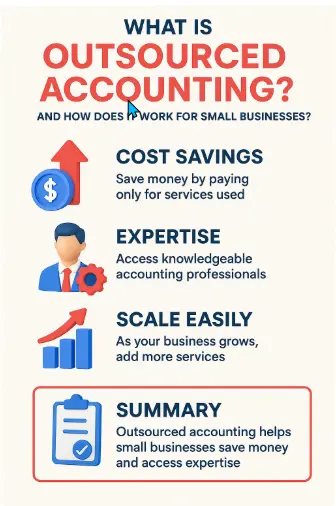
Lower cost than hiring full-time staff
Access to higher-level expertise and oversight
Greater accuracy through standardized processes
More time for revenue-generating work
Financial clarity that supports smarter decisions
It’s a practical solution designed for small teams that want reliable accounting without the complexity of running an accounting department internally.
Essential Resources on Outsourced Accounting for Confident, Well-Informed Decisions
1. Personiv — Your Deep-Dive Blueprint Into How Outsourcing Actually Works
If you want a full understanding of outsourced accounting before making a move, this guide lays out the entire process—from onboarding to monthly workflows. It’s a solid starting point for owners who want clarity, not guesswork.
Source: https://insights.personiv.com/blog-personiv/outsourced-accounting-complete-guide
2. Shopify — A Straightforward Overview for Founders Who Need Quick Answers
Shopify breaks the topic down into simple terms, making it ideal for small-business owners who want to understand the core benefits—time savings, accuracy, and reduced administrative load—without the jargon.
Source: https://www.shopify.com/ph/blog/outsourcing-accounting-services-for-small-business
3. Ramp — A Practical Timing Guide to Know When Your Business Is Ready
Ramp offers a clear framework we often share with new clients: it helps you identify the key signs you’ve outgrown DIY bookkeeping and need a more reliable financial system to support your next stage of growth.
Source: https://ramp.com/blog/outsourcing-accounting-for-small-businesses
4. Emapta — A Clean Breakdown of What “Outsourced Accounting” Truly Covers
This resource does an excellent job detailing the actual deliverables—bookkeeping, payroll, reporting, and compliance—so you know exactly what you’re paying for and how a provider should support your operations.
Source: https://emapta.com/blog/resources-guide-to-outsourcing-accounting-for-small-businesses/
5. Wiss — A Transparent Look at Benefits, Costs, and Common Risks
We appreciate this resource because it doesn’t sugarcoat the process. It shows both the value and the potential challenges of outsourcing, giving you a balanced perspective before choosing a provider.
Source: https://wiss.com/outsourcing-accounting-for-small-business-owners/
6. Unity-Connect — Helpful Guidance for Businesses Evaluating Fit by Size and Growth
If you’re unsure whether outsourced accounting is appropriate for your business right now, this guide helps you evaluate readiness based on your transaction volume, internal capacity, and growth trajectory.
Source: https://unity-connect.com/our-resources/blog/outsource-bookkeeping-for-small-business/
7. Outsource Accelerator — A Closer Look at How Outsourcing Improves Accuracy and Reduces Risk
This deep-dive highlights the operational advantages we see every day—better controls, fewer errors, and cleaner reporting—especially for businesses scaling without an internal accounting team.
Source: https://www.outsourceaccelerator.com/articles/outsourced-accounting/
Supporting Statistics — What the Data Shows (At a Glance)
1. Outsourcing Is a Common Small-Business Strategy
Over one-third of U.S. small businesses outsource at least one business function.
At Accountix Solutions we see this often — small owners hand off accounting first when internal bookkeeping becomes inefficient or risky.
Source: SBA+1
2. Outsourcing Accounting Commonly Leads to Cost Savings
Recent industry research reports that outsourcing accounting can deliver around 20% cost savings compared with in-house accounting.
From our real-world experience, these savings come not only from headcount reduction, but also fewer errors, cleaner closes, and more time for business-driving tasks.
Source: Personiv Insights+1
3. Scale & Compliance Complexity Makes DIY Risky
The Internal Revenue Service (IRS) processed more than 266 million returns and forms in fiscal year 2024 — illustrating the sheer volume and complexity of regulatory filings many small businesses may face.
In our work at Accountix Solutions, we often onboard clients stressed by shifting rules or missed filings — a major reason they choose outsourced accounting for accuracy and compliance peace of mind.
Source: IRS+1
Final Thoughts & Opinion
Key Takeaways
Fractional CFOs give small and mid-sized businesses access to high-level financial strategy without the full-time cost.
They help owners see around corners, reduce risk, and build systems that prevent cash-flow surprises.
In my experience, the businesses that win long-term are the ones that treat finance as a daily discipline—not a crisis response.
Why It Matters
Sustainable growth comes from forecasting, scenario planning, and operational clarity.
With the right financial partner, owners stop guessing and start leading with confidence.
My Perspective (Experience-Based)
After working with many operators, I’ve seen a pattern:
Businesses don’t fail from lack of opportunity—only from lack of financial design.
The moment a founder gets real visibility into margins, cash flow, and unit economics, decision-making transforms.
A Fractional CFO accelerates this shift by creating a financial system that grows with the business.
Bottom Line
If you want stability, scalability, and smarter decisions, a Fractional CFO is one of the highest ROI investments you can make.
Strong financial leadership turns chaotic growth into intentional momentum—and that’s what sets resilient businesses apart.
Next Steps
Assess Your Gaps
Identify your biggest financial pain points.
Note recurring bottlenecks.
Gather Key Documents
Recent P&L, balance sheet, cash-flow statements.
Sales and expense summaries.
Book a Consultation
Schedule a discovery call with a Fractional CFO.
Ask about experience, expected outcomes, and timelines.
Set Clear Goals
Define what you want: growth, clarity, cash-flow control, or efficiency.
Start With a Financial Health Review
Establish a performance baseline.
Uncover hidden risks and opportunities.
Implement the Plan
Deploy forecasting, dashboards, and cash-flow systems.
Track progress regularly.
Optimize Continuously
Review KPIs.
Refine assumptions as conditions change.
FAQ on “Outsourced Accounting”
Q: What is outsourced accounting?
A:
External team handles bookkeeping and finance.
Delivers higher accuracy without in-house overhead.
Q: Why is it valuable for small businesses?
A:
Saves time.
Reduces errors.
Gives clear financial visibility.
Proven to stabilize operations based on our client work.
Q: Is it more cost-effective than hiring in-house?
A:
Yes.
No salaries or training costs.
Avoids turnover.
Gains full-team expertise at a fraction of the price.
Q: What services are included?
A:
Bookkeeping
Monthly reports
AP/AR
Payroll
Tax prep support
These cover the tasks small teams struggle to maintain consistently.
Q: How do I know if outsourcing is right for me?
A:
Books often fall behind.
Cash flow feels unclear.
Too much time spent fixing numbers.
Need expert support without hiring full-time.